Total Pageviews

Saturday, January 25, 2014

Day #5 (1/22/2014) - Lake Masek and the Serengeti

Click here to visit a web gallery with more photos from today.

After our visit to Ngorogoro Crater, we drove into Serengeti National Park. After several hours of driving, we arrived at the Lake Masek Tent Camp, our home for the next 3 nights:


To call this camping is a bit of a stretch. Our large canvas and wood tent slept four:


It had a seating area:


and four 4-post beds:


The bathroom had a tub, toilet, and outdoor shower:


All is all it was a comfortable way to live right within the Serengeti. We were close enough to hear Cape Buffalo snuffling outside our tent (and to see the poop, footprints, and damage they left behind). And experiencing a thunderstorm from within the tent was fantastic.

The Tent Camp featured large tents for dining:


Oh, and if you want a massage, just turn left at the pile of elephant skulls:


After the sun set, you were required to be accompanied by a Maasai warrior back to your tent in case of wild animals. I was deeply disappointed that we never did encounter a single wild animal during these walks, thereby depriving me of the chance to see a Maasai warrior in action! Overall, this was a lovely way to spend 3 days feeling part of the Serengeti:


Each day within Serengeti National Park was spent game driving. This involved piling into our Land Cruiser with the top raised so that we could stand and look out. We drove on roads, trails, and off road, looking for wildlife. Whenever we spotted something interesting, Nickson could drive the truck to be as close as possible:


We saw many many wildebeest in groups of a few dozen to a few thousand, and countless other wildlife. Here is a small sample (you can click on the web gallery at the top of this page to see more):


One of the coolest aspects of spending a day on the Serengeti is watching small dramas unfold. We encountered this pair of leopards (a mother and daughter), a very rare site on the Serengeti:


The mother spotted some prey within a clump of bushes/trees:


She sent her daughter off to sit in the shade of some bushes:


After stalking the invisible prey for about 20 minutes, she suddenly pounced. An African wild cat scampered out of the bush and ran away, eluding capture. The leopard, temporarily spent, jumped up a tree to rest:


As we drove back for the evening, we were surprised to round a turn and run into a family of elephants, including some young ones:


When they noticed us, the elephants jockeyed position, placing the babies safely in the middle:


This was a behavior that we encountered many times: mothers protecting their young from us. It was all very Wild Kingdom!

All in all a fantastic day on the Serengeti. Let's do it again tomorrow!

Thanks for reading!

Thursday, January 23, 2014

Day #4 (1/21/2014) - Ngorogoro Crater

Click here to jump to a web gallery with more photos from today.

After we departed Endoro Lodge, we drove about 2 hours into the Ngorogoro Crater Conservation Area. Ngorogoro crater is one of the most amazing spots on Earth: A 6 mile wide cauldera (a depression left after the collapse of an ancient volcano) surrounded by a 1000' high rim that forms a natural bowl, a sort of land animal fish bowl. The flat plain at the bottom teems with wildlife. This overview gives a sense of the scale of it:


Before proceeding into the Crater, we spent the night at the Sopa Lodge, perched on the rim of the crater. This nice hotel had a swimming pool and spectacular views overlooking the crater:


Just before dinner, as they served us drinks on the patio, we watched the light break through the clouds as a rainstorm swept across the plain:


The next morning we awoke at 6AM (that was our guide Nickson's idea!) and drove down into the crater. We spent the morning on a game drive seeing incredible quantities of wildlife. It is quite bizarre to see, for example, ostriches just walking around, or dozens of zebras gamboling. Here is a small sample of what we saw that day. I will upload a complete photo set from the day when I have a better connection. For now, you'll have to settle for a cape buffalo, a baby hyena, an ostrich, and a pair of zebras:


The game drives are fairly tightly regulated. We have to stay on designated paths and we must stay in the vehicle. The tour operators communicate via radio so that everyone can see the interesting stuff. Like at Yellowstone, a cluster of vehicles pulled over is a sign that some large charismatic animal is afoot! 

We stopped for lunch at one of the only places you are allowed out, a nice picnic area with a large acacia tree providing some of the only shade in the crater:


We were warned to eat in the truck so that divebombing birds wouldn't steal our food!

After lunch, there was more game driving:


In the afternoon, we headed out of the conservation area and into Serengeti National Park (about a four hour drive all together). Along the way, we drove through areas that reminded us of Vermont, then Wisconsin, then Ireland: green hills and verdant valleys, teeming with wildlife, and dotted with Maasai villages. This was the first time that I was struck by the beauty of Tanzania's landscape itself, rather than the wildlife that occupies it. We drove a few hours into the park to the Lake Masek Tent Camp, where we are to spend the next 2 days and 3 night. More about that later!

Thanks for reading!

Wednesday, January 22, 2014

Day #3 (1/20/2014): Near Endoro, Tanzania

Click here to jump to a web gallery of 50 images from today.

While yesterday was all about viewing wildlife, today was all about viewing the Tanzanian people and their culture. After breakfast at Endoro Lodge, we met our walking guide Steve for a morning hike through the area:


Steve is wearing the traditional colors of his tribe. We spent many hours walking along roads and trails through the local countryside, stopping to meet people, view their homes, and watch them work:


A typical Tanzania home is made of local red brick, with well-tended gardens (for both food an ornamentation) and a variety of animals. I didn't see anything that I would describe as squalor or abject poverty. People were, for the most part welcoming, although sometimes a bit shy.


I particularly enjoyed meeting local children. I would always ask before photographing them, and they acquiesced about half the time. This boy was returning from the local well. Most Tanzanians walk from 1 to a few kilometers to retrieve drinking water from a public tap. This job is usually relegated to the women and children.


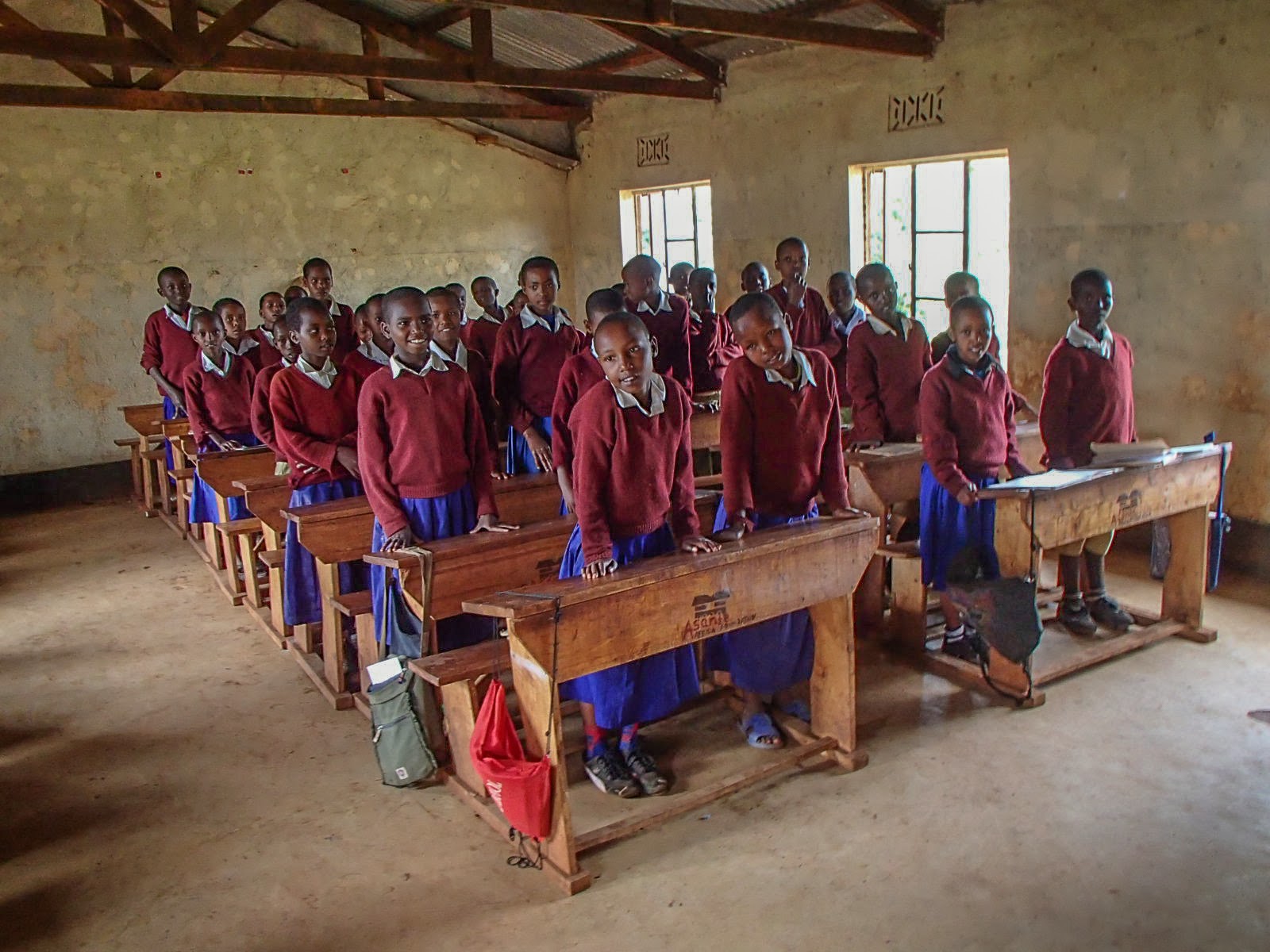
About half way along our walk, we visited a local school. It serves children from kindergarten to 7th grade. The children walk up to 5 km each way to attend the school (think of that next time you are training with Couch to 5K!). They take an exam in 4th grade that they must pass (or be held back) and then an exam in 7th grade that determines whether they may continue to secondary school. Our first stop was the teachers' lounge:


We visited the 6th grade English class. They enthusiastically practiced their English with us. First, they sang us several songs, some of which we recognize (like the "Skinamarink" song). Then they introduced themselves and asked us questions about America (Did we have national parks? How did we travel to Tanzania? Why did we come to Tanzania? Do we have any pets?). We then spread through the class as the children practiced their readers with us:


After they sang us a goodbye song, we left the English class and joined the 7th grade dancing class beneath a large shady tree. They played drums, sang, and danced several songs for us, including an Africanized version of "We Are the World" (providing a weird life-imitating-art-imitating-life moment) and "Hakuna Matata" (imagine my shock upon discovering that Disney didn't make that up!). 


We ended our visit by meeting with the headmaster, who explained the needs of the school, and how it all works. We made a donation and continued on our way through the local villages. We passed many people performing manual labor (we saw no farm machines) including a local community brick oven:


We ended our walk at a local town, visiting the daily market (a combination farmers' market and flea market, with mostly used goods for sale):


All in all it was a wonderful day of interacting with the local Tanznian peoples and culture. On the whole, everyone was friendly and welcoming. There was a bit of the "scamming" that comes with being an American abroad (attempts to engage in fake conversation in order to ask for money or sell cheap goods), but it was mellow enough to be unobtrusive. We were followed by a "town drunk" for a while before our guide bribed him to go away! I came away feeling that the average Tanzanian lives a good, healthy life. It was nice to have a day that was all about the people in the midst of so many days that were all about the animals.

Thank you for reading! I'm sorry it took so long to upload this blog; the Internet situation is fairly miserable.  :-)  No telling when my next update may be!


Monday, January 20, 2014

Day #2 – Safari Lake Manyara, Tanzania

Greetings from Endoro Lodge, near Lake Manyara, Tanzania.

Click here to jump to a web gallery of 50 images from today.

I am writing this entry at breakfast of day #3. Yesterday was quite an adventure – an affirmation of why we came to Tanzania and an official crossing-off-the-bucket-list day.

We started our day at Kigongoni Lodge near Arusha with a nice American-style menu-ordered breakfast on the outdoor patio. We were running a bit late, so our driver/guide Nickson briefed us on the day’s adventure:


We loaded everything into our Toyota Land Cruiser, which serves as our base of operations for the trip. It is quite comfortable, with seating for 9, a roof that raises several feet (but stays on) for wildlife viewing, a cooler, electrical plug, etc.:


We drove along the main highway through many towns and villages. Along the way, we saw an equal mix of pedestrians and drivers, as well as many herds of animals (ranging from a few to a few dozen, often corralled by children) eating vegetation along the side of the road:


We also passed many small Maasai villages, two of which we will visit later in the trip:


After about 2.5 hours of driving, we arrived at our destination: Lake Manyara National Park. This large park surrounds a salt-water lake that rises and falls significantly with the season (we are currently in a dry period), providing broad habitat for a large variety of wildlife:


We spent the day in our vehicle (you are not permitted to walk in this park) driving along muddy roads spotting wildlife. The roof was raised up so that we could stand (the boys stood on the seats) and lean on the cross bars to view the animals. Our driver would stop any time we spotted something – about half the time, he would spot it first, about half the time one of us would spot it, most often Forest. We could spend as much time as we wished observing and photographing the wildlife, and Dickson would inch the truck forward or back to facilitate the best view.


We stopped for lunch at a picnic area overlooking the lake. It was rich in bird life and offered wonderful views. We enjoyed an American-style boxed lunch (sandwiches, salad, brownie, etc.):


For the rest of the afternoon we toured the park spotting wildlife. It was spectacular! It reminded me of a drive-through safari theme park but, you know, for real. Some of the views were spectacular. I mean, hold cow! Zebras! Lots of them! And giraffes! And look at those elephants! You get the idea. It’s hard to choose just a few photos of wildlife to show here. You can see the gallery of 50 photos from today by following the link at the top of this page. Here are a few to whet your appetite:


We left the park around 4PM and drove to our new lodging, Endoro Lodge. This was quite a nice place, with clean spacious bungalows (ours had 3 bedrooms + 3 baths), really well manicured grounds, and a swimming pool that we enjoyed:


The people of Tanzania are wonderfully friendly and welcoming. I am aware that we are traveling in something of a "white man's bubble". The service is beyond what I would normally expect. Whenever we arrive in a new place, we are greeted with hot towels and fresh squeezed local juice (hibiscus, baobab, passionfruit). We never carry anything. When we finished dinner last night, a man with a large flashlight was waiting for us outside (how long had he been there?) so that we didn't have to walk back in the dark. When we visited the pool, a very nice man named Richard stayed with us the whole time, making sure we were comfortable. It's nice, but I also feel a bit of liberal guilt about the whole thing. Tourism is Tanzania's #1 industry and provides many desirable jobs. But I can't help wondering if we are spoiling that which we come to see. For example, Endoro lodge had Maasai teenagers working as porters. Am I, in some small way, contributing to the destruction of their culture? I have thought a lot about this while we have been here but have not yet settled upon a final opinion. I have spoken to our guide about it, and although he sees my point, he feels that anyone taking a tourist job can (and often do) return to their tribe once they have saved money (to buy cattle, for example). More thoughts on this as they develop!

We enjoyed a buffet dinner (great curry! weird desserts) at the Lodge, with a lovely patio with a fire pit and fragrant views. We slept fitfully (lots of strange animal noises both familiar and exotic).

Thanks for reading!

Saturday, January 18, 2014

Day 1 (January 19th, 2014) - Kigongoni Lodge, Near Arusha, Tanzania

Greetings from Tanzania!

We are currently awaiting breakfast at our first lodge after a long day of travel. We left our house in NH at about 2PM, drove to Boston, flew overnight to Amsterdam (no one slept much), stayed in AMS for a few hours, then departed at 10:15AM for Kilimanjaro, arriving around 8:30PM local time. It took about an hour to work our way through the airport ($100/person for a visa, we were photographed twice, and they electronically recorded all my fingerprints) and then we met Nickson (sp?), our guide from Massai Wanderings.

We were immediately struck by the moist, tropical, and fragrant nature of the air.  We drove for about 45 minutes along the main highway in the area, past gas stations, supermarkets, and small towns with active parties (neon lights, music, etc.). Overall, everything appeared a bit  more developed than I had expected. The road was well paved and commercial/industrial buildings were common. It appeared more developed than many parts of Belize (or the US deep south) that I have visited.

We arrived at the Kigongoni Lodge and were greeting with glasses of freshly squeezed baobab juice (tasted like a mild orange mixed with apricot) and then porters delivered our bags to a large thatched-roof comfortable bungalow. After 25 hours of traveling, we slept easily under mosquito netting.

I arose around 7AM to photograph the grounds. The family slept until 8. We are now enjoying breakfast on a large outdoor patio surrounded by exotic plants, mysteriously rustling bushes, and abundant birds sounds. I've dropped a few photos below to get a sense of the grounds.


I am very excited to head off to Lake Manyara and the Crater Highlands today to start our safari!

Thanks for reading!

Tuesday, November 26, 2013

The course is on!
To reserve your spot, register for:
LAS-1990-1 CRN#410  Travel Course - Tanzania

When you register, the course fee of $3995 will be added to your student bill.
Paying that balance insures you spot.

Spots are limited so sign up today!