Total Pageviews

Monday, February 3, 2014

Day #8 (1/25/2014) - A visit with Maasai

Click here to jump to a web gallery with 58

photos from today.

After a nice breakfast at the Escarpment Lodge, we departed for our final day in Tanzania. As we drove through towns, I snapped many photos to document life in Tanzania. We passed many homes made of wood and mud:


I enjoyed watching the daily lives of the Tanzanians:


We arrived at Esilalei, a Maasai village with whom our tour company (Maasai Wanderings) has a longstanding relationship. We were greeted by our guide and one of the local schoolteachers:


Our guide was a villager from Esilalei:


He told us that he was the only person in his class of 70 to pass the 7th grade examination to gain entrance to secondary school. Even so, his family could not afford the tuition (all secondary schools, even the government-run schools, require payment; free education in Tanzania is guaranteed only through 7th grade). So his village combined resources to send him to secondary school. He then passed the examination to gain entrance to college, where he paid his own way through the government university by taking jobs. He trained to be a guide. So now, he has returned to his village, leading visitors on trips, and bringing tourist dollars to Esilalei. It takes a village to raise a guide in Tanzania!

We started our visit at the local Maasai school, a kindergarten that services over 60 children ranging in age from 5-7. We met the school teacher:


 He showed us the kindergarten, a cinder-block building consisting of a single room:


He explained that this school had been built with proceeds from Maasai Wanderings as part of their partnership. This building replaced the old school, which met in the shade of this tree:


 Yes, that tree used to be the school! So the single-room building is a significant step up. They are in the process of building a second room for 1st grades. And they have this playground:


Because it was a Saturday, only some of the students were present to meet us. They were typical kindergartners, if a bit more raggedy in their appearance that our standards. They were all friendly and were eager to wave, touch us, and pose for photos. I took many photos of the schoolchildren which you can see the gallery link above:


After visiting with the children, we visited the headmaster in the teachers' office (which doubles as a kitchen). We delivered a suitcase full of school supplies (notebooks, pencils, art supplies, etc.):


I asked what supplies the school required upon my return in May. He asked for chalk (white and colored), notebook, and pencils. And that was it! I asked if he, the teacher, needed anything. After some prodding, he said "A motorbike". Sorry!

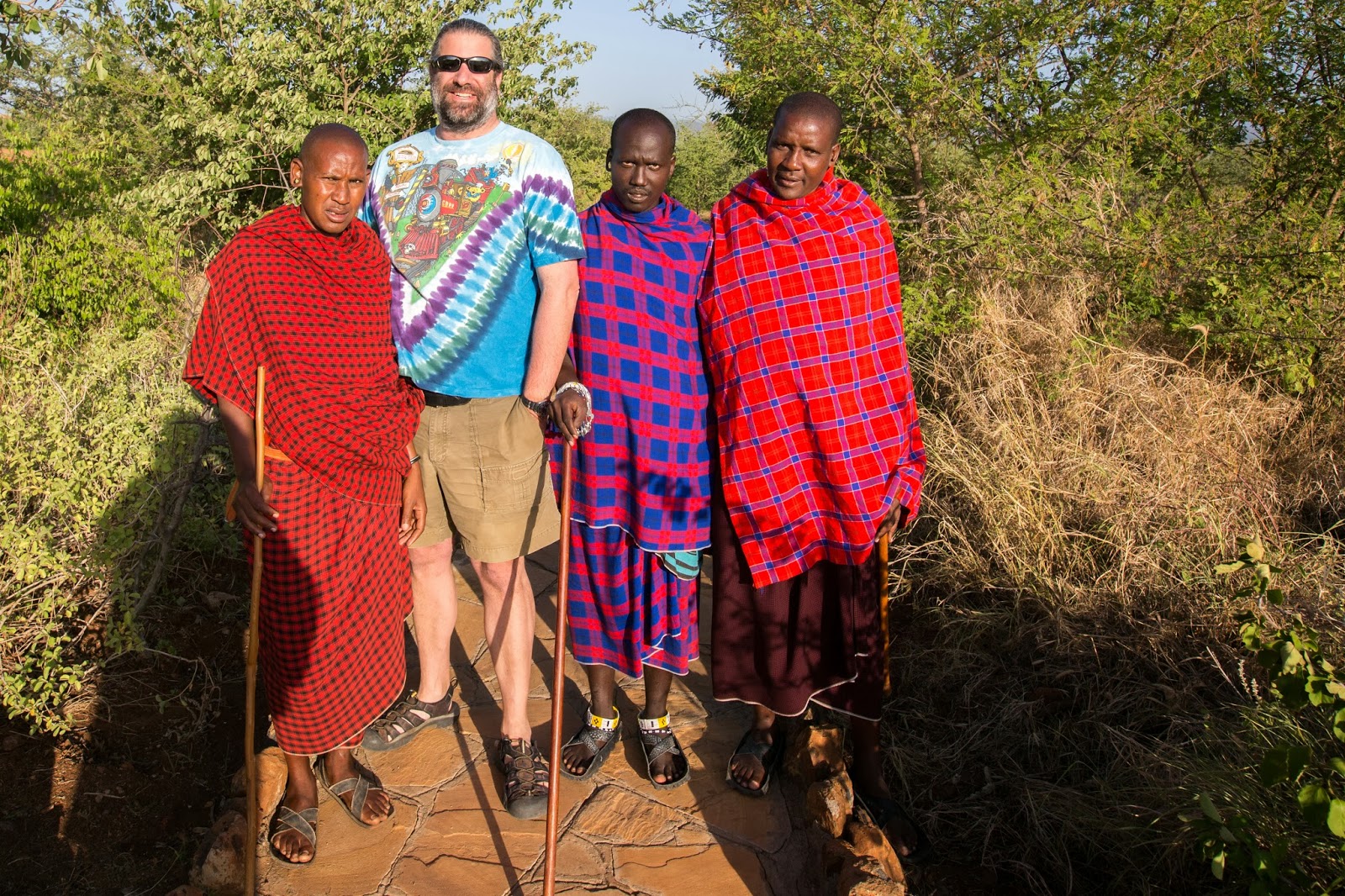
Before we left, Reed commented on the teacher's walking stick. Reed had been on the lookout for an authentic Maasai walking stick for a few days, and this was a particularly beautiful example, expertly hand carved from a rare type of acacia. The teacher said that it was worth a small cow. After offering my tie dye T-shirt and a Red Sox hat in trade, we settled on my watch, and the swap was made:


Our guide then led us on a walk, showing off medicinal plants in the area:


Our walk ended at the Maasai village of Esilalei, which can be seen here outlined by stacks of thorn-bearing acacia branches that help keep out animals:


In addition to traditional Maasai herding practices (the men subsist almost entirely on the meat, milk, and blood of cows), Esilalei uses tourism to sustain the village. Everyone was welcoming and happy to pose for pictures as our guide explained the various dwellings and implements:


The woman and girls of the village gathered in a large circle to sing and dance greetings for us. They had handmade beaded trinkets arranged on blankets for sale (bracelets, purses, and the like). We bought our share, assured that the proceeds were shared collectively among the tribe (so it didn't matter from whom we purchased):


I will admit that, prior to our visit, I anticipated that Esilalei would be a Disney-fied Maasai village set up for the amusement of visiting tourists, but I quickly realized that this was just a regular village of people living the Maasai lifestyle, with the occasional visitor whom they welcomed. There is no mistaking a modern Maasai woman for an American!


All in all, this day was the most cultural experience we had in Tanzania, and a wonderful capstone to our trip. I plan to return in May with students and look forward to bringing another suitcase full of school supplies.

We drove back through the town of Arusha, ending up at the Kigongoni Lodge, the first place we stayed upon landing in Tanzania. There we had a day room that allowed us to shower, change, repack, and enjoy dinner before heading to the Kilimanjaro airport. Flights to Dar A Salam, Amsterdam, Boston, then a drive home, returning 30 hours after we left.

We bought back thousands of photos, a handful of souvenirs, and life-changing memories to last all our days!

Thank you for reading!
Tune back in May when I return with students....

Thursday, January 30, 2014

Day #7 (Jan. 24th, 2014) - Leaving the Serengeti

Click here to see a photo gallery featuring 20 photos form today.

Today was our last day on the Serengeti. After our usual Western-style breakfast, and packing our usual lunch boxes, we packed up all our suitcases and said goodbye to our hosts at Lake Masek Tent Camp. We departed around 9AM for our final game drive across the Serengeti.

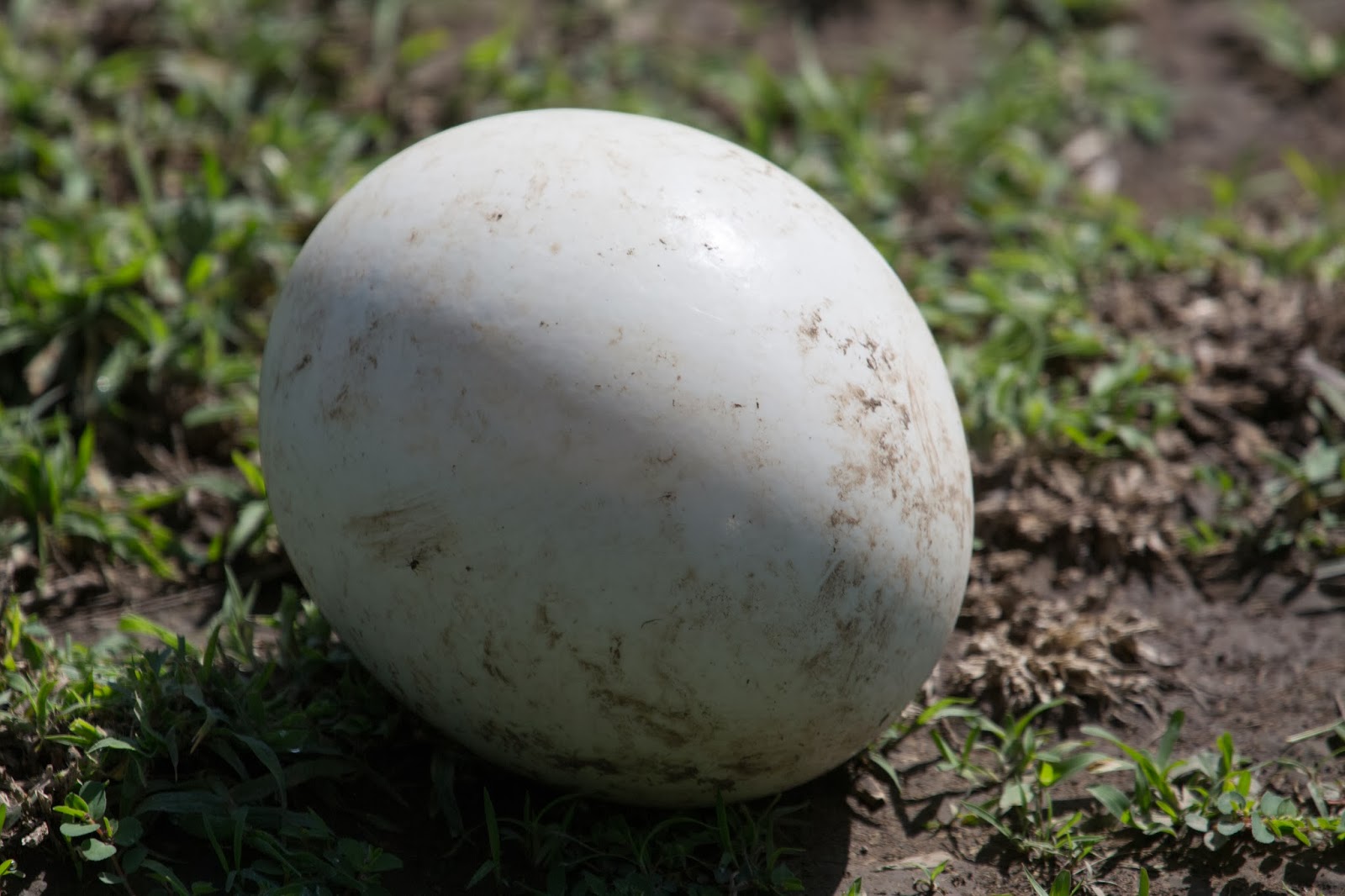
Game driving reminds me a lot of snorkeling on a coral reef: it's basically the same each time (you're always traveling over the same landscape) but different every time, and you'll never know what you see. You see a lot of the same organisms as you usually see, but then you'll see new combinations, new conditions of light and weather, and the occasional rarity that really grabs your attention. During this particular drive, for example, we just happened to come upon an ostrich egg. Just sitting there on the ground. No ostriches in sight. Weird!


This lead to a long conversation with Nickson about the mating and nesting habits of ostriches.  :-) 

The most common sight on the Serengeti is large herds of wildebeest, numbers from dozens to thousands:


Few things are as impressive as a thundering herd of wildebeest crossing your path. They have evolved behaviors that help ward off chasing predators: they tend to cut back/forth a lot when they run (like a soldier trying to avoid bullets), and they tend to kick their hind legs in unison, like a bucking bronco. It's impressive to watch such a large beast move that way. Whenever I saws a herd crossing the road, I wanted our truck to speed toward them so that I could watch them scatter! Not cool, I suppose.

This shot gives a good sense of how close we could sometimes get to the wildlife:


We spent about 45 minutes watching/stalking a cheetah as it watched/stalked some gazelles:

It is amusing to see a dozen safari trucks scrambling for position every time the cheetah moved. The drivers try to anticipate where the cheetah is going, and then place the truck in the path. As is so often the case, nature was more patient than we were, so we left without seeing any pouncing.

We drove our way out of the Serengeti National Park by speeding across the wide-open plain for about an hour. It was really awesome. Forest and I stood in the front row facing forward (me standing on the floor of the truck, he in bare feet standing on the seat) as we raced across the Serengeti, sometimes on well-worn trails, sometimes across open territory. The wind whipped our faces as we viewed the wildlife dotting the landscape out to the horizon in every direction: wildebeest, gazelles, and zebras being the most common. This photo shows a jackal, with wildebeest in the background:


The scale of it all was so vast, and yet we knew from the previous day that dramas play out on every patch. Here is how we looked when it was over:


Upon leaving the Serengeti, we spent several hours driving across local roads to our next destination. We frequently passed individual or groups of Maasai tending to their flocks along the side or the road, or congregating in the shade:


By late afternoon,we arrived at the Escarpment Lodge, our last overnight accommodations in Tanzania. This lodge was unusually nice, with lovely common areas, a stately dining room, and a porch with views of Lake Masek on the valley floor below:


This lodge also had a pool, always a welcome sight after a hot and dusty day:

In this photo, notice the trail down the dirt ridge to the right. This trail was used by locals because there is an exposed freshwater spring on the valley floor. As we sat at the pool, we watched children leading lines of goats for a drink. The children climbed back up the hill carrying containers of water for their homes. It didn't take a very active mind to appreciate the difference in circumstances.

As with every lodge, this one featured Maasai warriors to act as security and escorts:

We enjoyed a nice dinner (the best one in Tanzania) and settled in for bed in adjoining bungalows, knowing that tomorrow would be our final day in Tanzania.

Thanks for reading


Tuesday, January 28, 2014

Day #6 (Jan. 23rd, 2014): Game Driving on the Serengeti

Click here to view a web gallery with 36 captioned photos from the day.
Click here to view a YouTube video from this day.

We awoke at the Lake Masek Tent Camp and had our usual Western-style breakfast (omelets cooked to order, bacon, fruit, yogurt, fresh juice, coffee/tea, etc.) and then packed our lunch boxes for the day. We agreed to take one long game drive today instead of two shorter ones, giving us more time to drive farther afield into the wide open Serengeti. Nickson prepared our truck as he did every day, by cleaning and organizing it inside and out:


We settled into the routine of game driving. We would careen down dirt paths, splash through puddles, struggle through muddy patches, seeking out interesting wildlife:


Once spotted, Nickson would drive off road to get us close, giving us enough time to observe and discuss and take photos, leaving only once we said "We're good, thank you!". Look! A giraffe!


I know how that giraffe feels! We also spotted a pride of lions feasting on a fresh kill. They all had full, swollen bellies, as they took turns eating within the protective shade of some bushes:


On this day, we ventured far into the "never-ending plain" of the Serengeti, a wide open expanse of scrubby grassland with few trees. The landscape was dotted with (in order of popularity) wildebeest, gazelles, zebras, and many other species. Their numbers were staggering, covering vast areas all the way to the horizon in every direction. And yet in every small patch, unique stories unfolded.

Sight we saw that day included a flock of ostriches, which look so funny when they run:

A lion lounging beneath a tree, sporting the only radio collar I saw during the trip:

A large pride of lions resting after a meal, including the only full-maned male I saw on the trip, and the only lion cubs I saw on the trip:


 We stopped for lunch beneath some acacia trees:


After lunch, we spotted a cheetah eating a recent kill (a pregnant gazelle). Cheetas are usually fairly weak after the spring, so they gorge on their meals, knowing that they will not be able to defend them from other predators. As we watched, a group of vultures slowly gathered about 50 feet away. As their numbers increased, they crept slowly closer to the meal. We left before the final confrontation.


Death is everything on the Serengeti. We would see at least five kills a day, usually with vultures and other birds picking apart the fallen animal. There were bones and skulls everywhere. Once you started to notice them, their bleached-white appearance became easy to spot:


We headed back toward the Tent Camp, stopping to see some lions along the way. This photo gives a good sense of how close we were able to get:


Just as we were returning to camp, Nickson spotted a family of elephants bathing. This was a highlight of the trip, seeing two babies, several adolescents, and several parents frolicking in the mud and water. They were clearly enjoying themselves, bleating and running around. This was a real treat to see:


Click here to view a YouTube video of these elephants.

We returned to our Tent Camp around 4PM, very satisfied with our day on the Serengeti. We spent the afternoon relaxing, playing games, wandering the grounds, and working on our trip journal. We enjoyed drinks on the back patio, where we could see hippos rising out of the lake to feed, in front of a fire. We had our usual buffet dinner, which always included dishes both familiar and local. Once darkness settled, we were required to always walk with a Maasai warrior escort in case we ran into any animals. We settled down for our final night on the Serengeti and were treated to a loud thunderstorm. That was a real highlight for me: hearing the wind and the claps of thunder just a few inches beyond where I was sleeping. Thanks for the great send off, Serengeti!

Thanks for reading.

Tomorrow: We depart the Serengeti and head into Maasai territory.